Sunlight > Diabetes?

Sunlight Lowers Your Blood Sugar. Your Phone Might Be Raising It.
TL;DR
- The new landmark: A study just published in Scientific Reports (Stevenson, Weller, Lindqvist & Dibben, 26 Aug 2026) tracked 429,368 UK Biobank participants and found that more ambient UVA in the days before a blood test meant measurably lower blood glucose — strongest in winter, when people are most light-starved
- It's not a straight line: The benefit is steepest at low sunlight levels and plateaus once you've had "enough" — meaning you don't need to move to the equator to get most of the effect
- It's not about vitamin D: The glucose drop shows up even in winter, when UVB (the vitamin D wavelength) is too weak to do anything in high-latitude countries — pointing to a separate mechanism: nitric oxide and mitochondrial light response
- The dose-response is real: People who used sunbeds occasionally or frequently had a 14–22% lower hazard of developing type 2 diabetes than non-users, tracking right alongside their measured vitamin D and blood glucose
- Meanwhile, your phone works the opposite angle: A separate randomized trial found that just 25 minutes of phone radiation next to the head increased total calorie intake by 22–27% — and the extra calories were mostly carbohydrates
- Same root system: Both stories run through the same territory — brain energy status, autonomic signaling, and how modern light and radiofrequency environments are rewriting your metabolic defaults
Welcome back to the rabbit hole.
Here's the pitch you've been sold for forty years: sunlight is a hazard to be managed, and if you want it's one legitimate benefit, take it in pill form. Vitamin D supplement. Problem solved. Go back inside.
Here's what a paper released this week actually found: your blood glucose moves in response to how much ambient sunlight hit your skin in the last two to seven days — and the effect has nothing to do with vitamin D at all.
The Study: What 429,368 People and a Decade of UK Weather Data Actually Show
The paper is titled, plainly, "Sunlight exposure is associated with lower blood glucose levels and type 2 diabetes," out of the University of Edinburgh and Karolinska Institute, accepted just weeks ago and published online August 26, 2026. It's a serious piece of work — UK Biobank data cross-referenced against satellite-measured daily UVA from JAXA (the Japan Aerospace Exploration Agency, Japan's version of NASA), using two independent methodologies designed specifically so their biases wouldn't overlap.
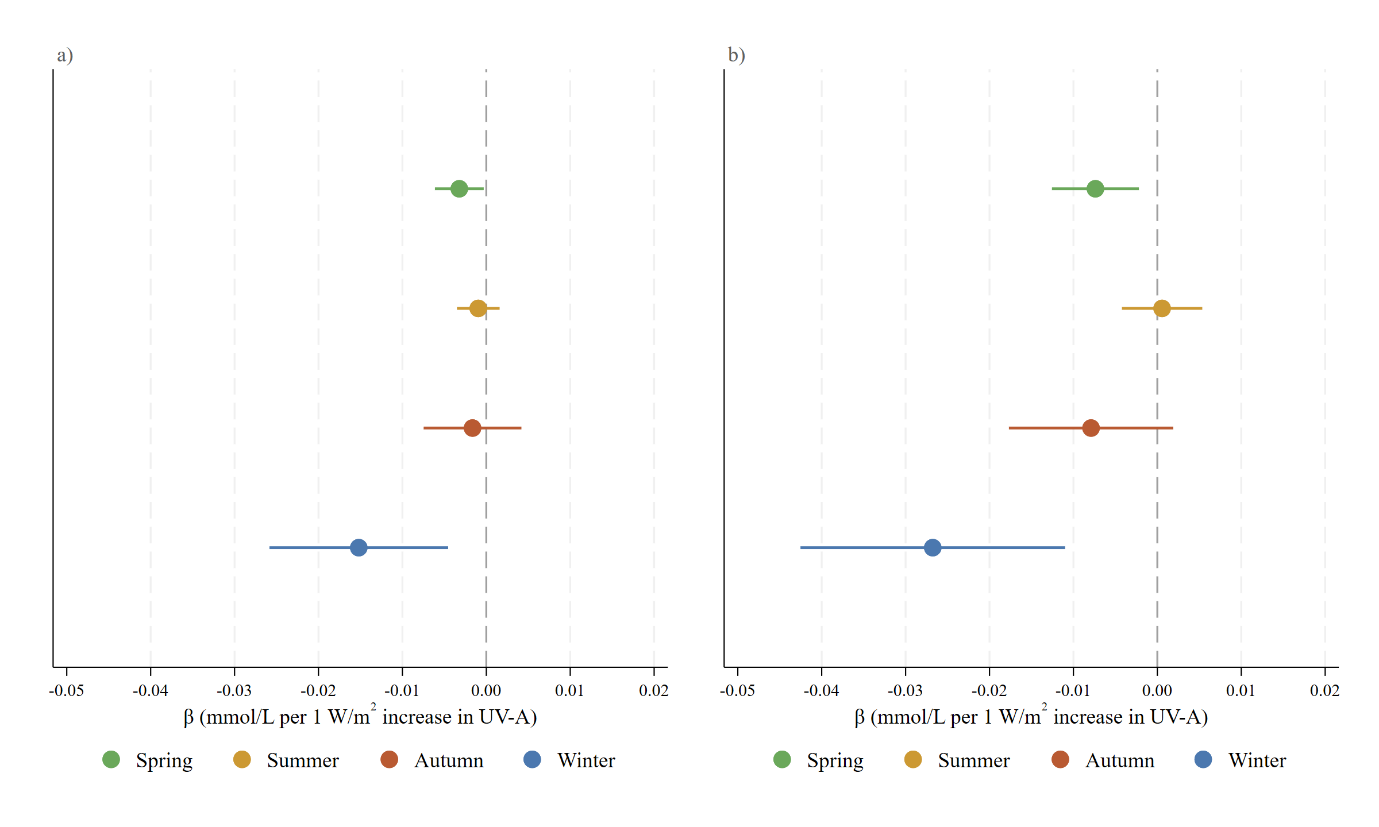
The core finding, in plain units: W/m² (watts per square meter) is simply how much UVA intensity was hitting a given location on a given day — think of it as the "sunlight dial" for that spot. mmol/L (millimoles per liter) is the standard unit for blood glucose concentration; a normal fasting reading typically sits somewhere between 4 and 5.5 mmol/L.
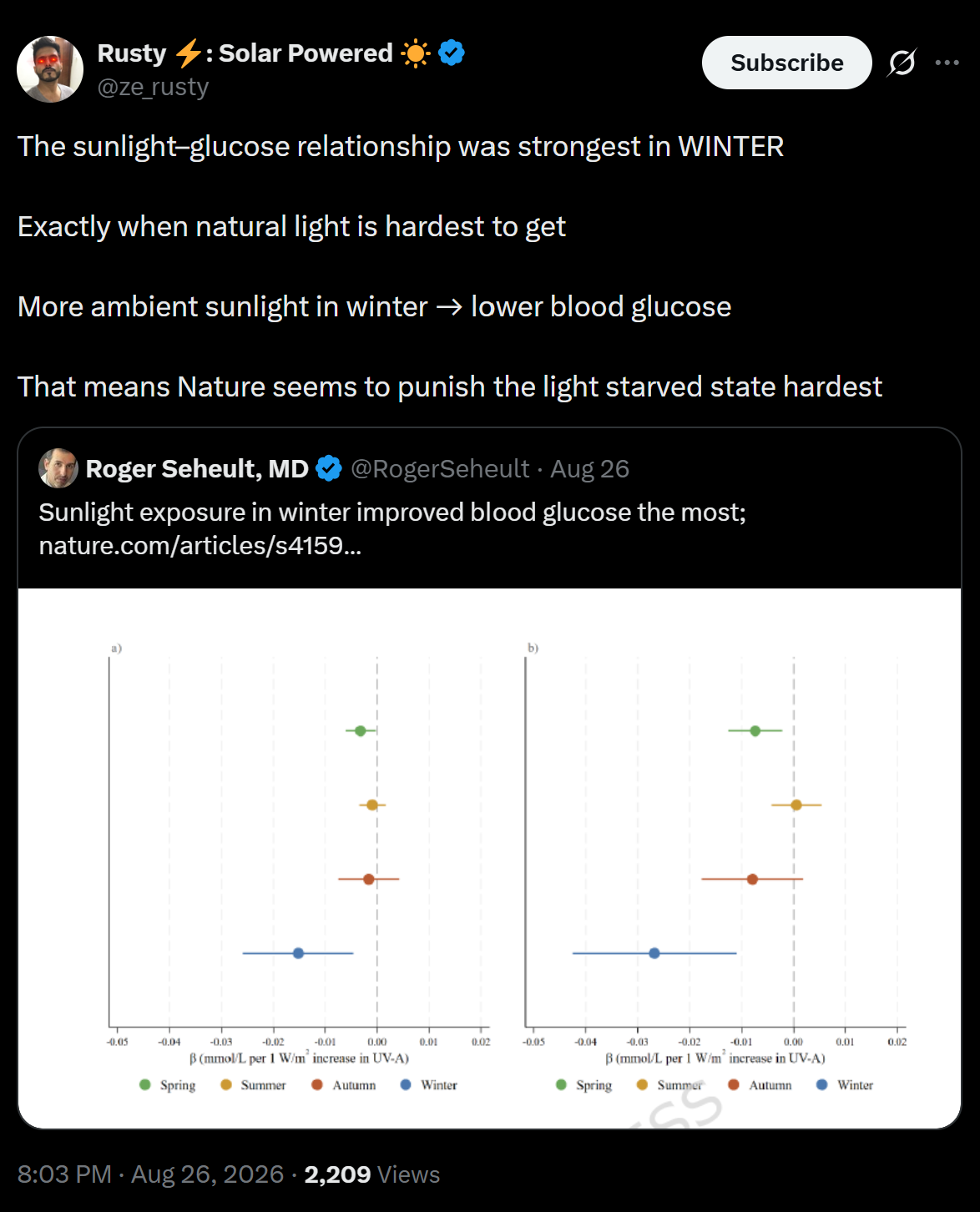
So when the paper says a one-unit rise in the sunlight dial moved glucose down by a few thousandths of a mmol/L, that's a small nudge per unit — but it adds up across a whole population and a whole season. In winter, every 1 W/m² increase in 2-day average sunlight exposure was associated with 0.015 mmol/L lower blood glucose, and 0.027 mmol/L lower for the 7-day average. In spring, the 7-day effect held at 0.007 mmol/L per unit.
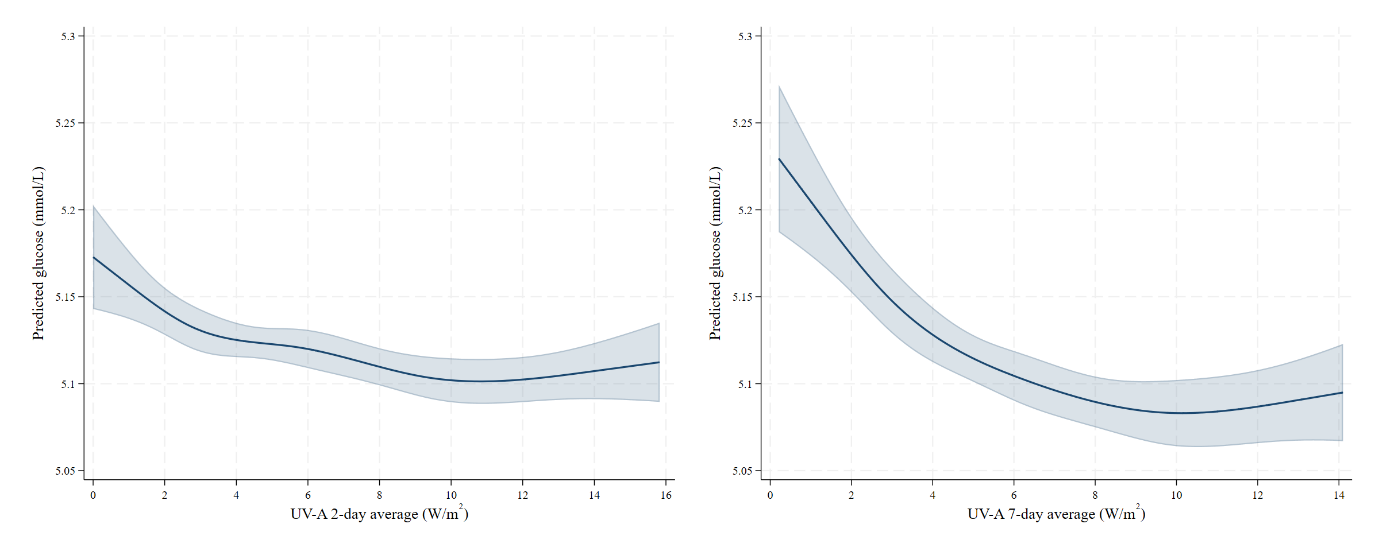
The researchers also modeled the relationship as a curve rather than a straight line, and the shape matters: for the 2-day exposure window, predicted glucose dropped from about 5.17 mmol/L at the lowest sunlight levels to 5.11 mmol/L once exposure hit a moderate range — and then flattened out, with no further improvement at higher exposures.
That's the whole point buried in the data — you don't need to become a sun-worshipper. You need to stop being sun-starved.
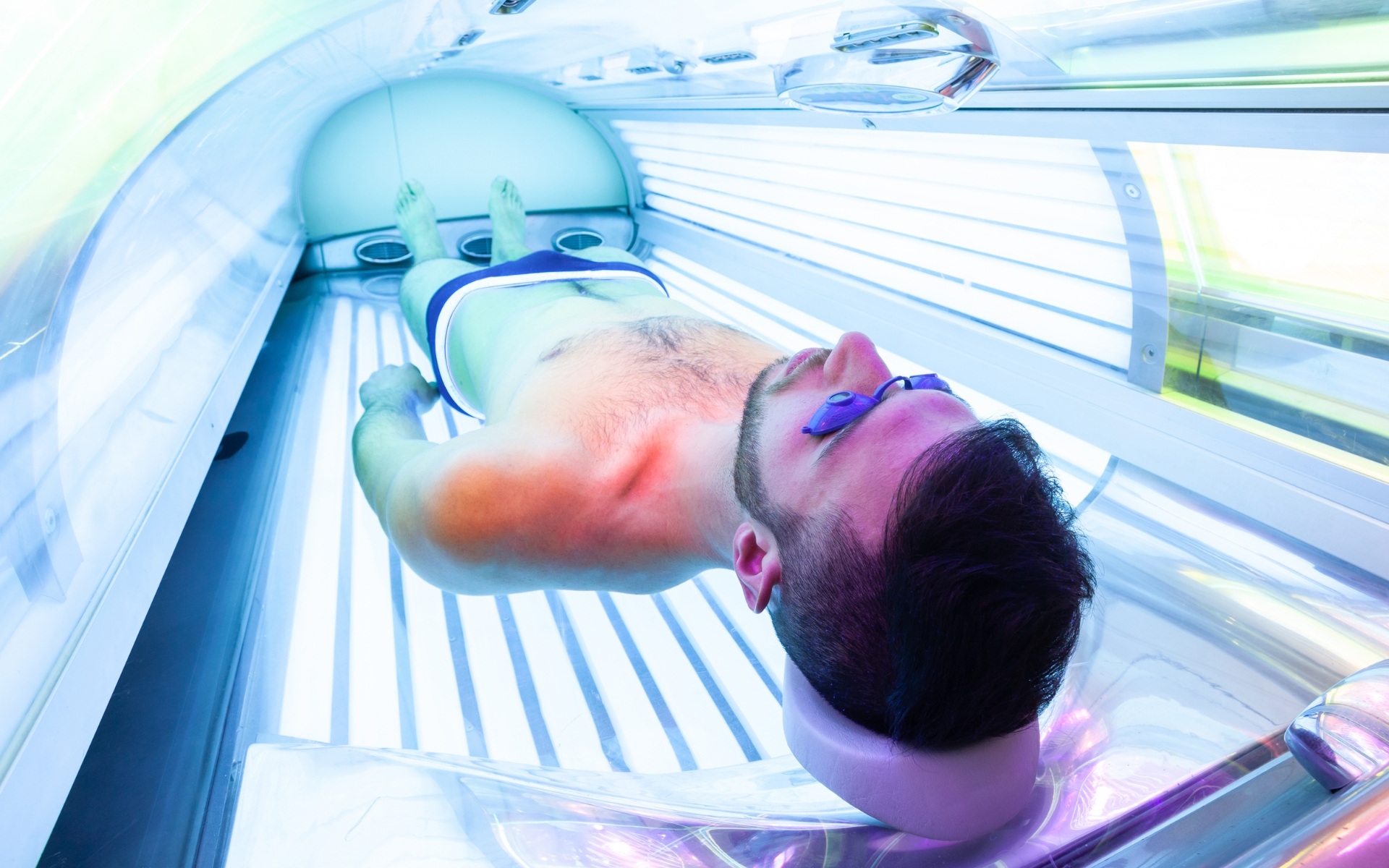
Then there's the chronic side. Using a sunbed as a marker of habitual sun exposure, the researchers found occasional users carried a 14% lower hazard of developing type 2 diabetes than non-users, and frequent users a 22% lower hazard — a statistically significant, dose-dependent trend across the three groups. Frequent users also had meaningfully higher vitamin D, lower BMI, and lower blood glucose than non-users. And this is completely by artificial means! The sun will always be the most complete spectrum of UV and IR. It's what our biology is wired for and why results from the sun itself would likely be better, perhaps significantly.
Here's why the results are more interesting than they may sound. Sunbed users in the data actually looked less healthy on paper than non-users on several counts — they smoked more, lived in more deprived areas, and had less formal education, all things normally linked to worse metabolic outcomes. If those factors were driving the result, you'd expect sunbed users to have higher diabetes risk, not lower.
With this in mind, researchers statistically separated out each of those variables — mathematically holding smoking rates, deprivation, education level, and physical activity constant across groups — and asked: once you account for all of that, does sunbed use on its own still predict lower diabetes risk? It did, and the protective effect remained statistically significant even after those adjustments.
In other words, this wasn't simply "healthier people happen to also use sunbeds." Sunlight exposure held its own signal even while working against a stacked deck of other risk factors that should have pushed the result the other way.
Why This Isn't a Vitamin D Story — And Why That Matters
Here's the detail that should stop you: this glucose effect was strongest in winter, when UVB — the wavelength that makes vitamin D — is essentially inert at UK latitudes. The atmosphere absorbs most winter UVB at that latitude, so vitamin D synthesis basically shuts down for months. UVA, the longer wavelength, stays biologically active year-round regardless. If vitamin D were driving this glucose effect, winter should show nothing. Instead, winter showed the strongest signal.
So what's actually happening? Two candidate mechanisms, both well-documented outside this paper:
Nitric oxide. UVA hits stores of nitric oxide in your skin and releases it, with levels staying elevated for 24 to 48 hours afterward. NO is a vasodilator — it lowers blood pressure — and it also regulates something called the NLRP3 inflammasome, a key driver of the low-grade inflammation that underlies insulin resistance and type 2 diabetes. That release matters because nitric oxide improves blood flow, boosts insulin secretion, and improves insulin sensitivity — three separate levers on glucose control. In mouse studies, blocking the NO pathway directly reversed the metabolic benefits of UV exposure, which is fairly strong evidence this is the actual mechanism at work, not a coincidental side effect.

Worth knowing: skin isn't the only place your body makes nitric oxide. Your nasal passages and paranasal sinuses produce it continuously, and nasal breathing — as opposed to mouth breathing — carries that nitric oxide down into the lungs with every breath, where it helps with oxygen uptake and blood vessel dilation. This is part of why Buteyko-style reduced breathing and nasal breathing practices are worth taking seriously alongside light exposure: they're tapping the same NO system from a different entry point, whether the sun is out or not.
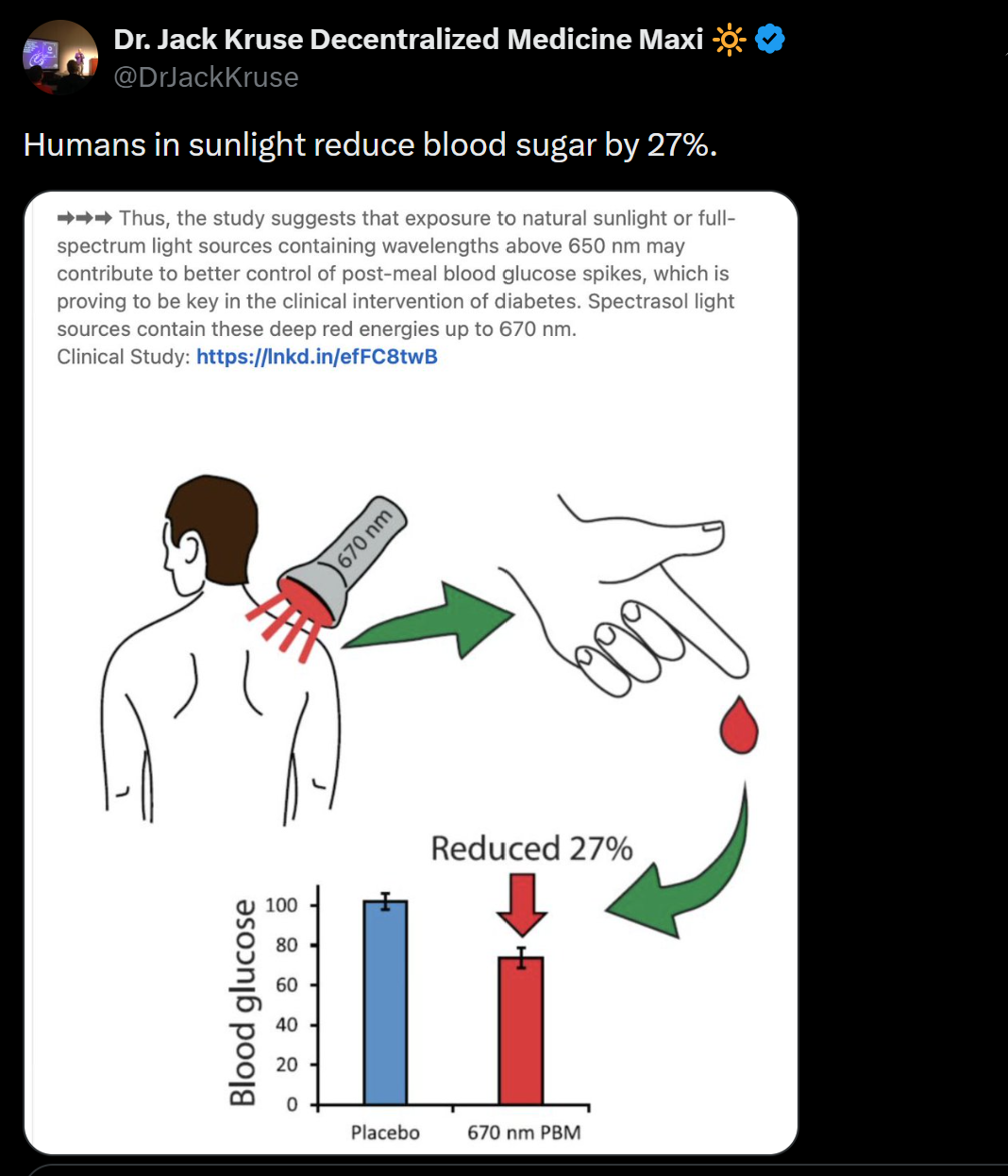
Mitochondrial light response. Red and near-infrared light, the 650–900nm range that's abundant in natural sunlight but nearly absent in LED indoor lighting, directly upregulates mitochondrial ATP production. In a clinical trial cited in the paper, participants exposed to just 15 minutes of red light had 28% lower blood glucose after a glucose load compared to a placebo group. Meanwhile, shorter-wavelength blue light — which dominates LED and screen environments — has the opposite effect, raising blood glucose and disrupting the circadian signaling that governs insulin sensitivity.
Put those together and you get a genuinely uncomfortable conclusion: it's not that indoor life lacks vitamin D. It's that indoor life has swapped out an entire spectrum your mitochondria evolved to run on, and kept only the wavelength doctors know how to measure.
🔬 PROOF OF WORK PROTOCOL
Anyone can tell you to "get more sunlight." Exceptional data can show you what your body is actually doing with the light, food, and EMF load you're currently under. Functional lab testing gives you the verifiable results — mitochondrial markers, inflammatory load, glucose regulation patterns — instead of a guess dressed up as advice.
Contact Your Health Detective
This Isn't New — It's Just Finally Being Said Out Loud
Richard Weller, one of the co-authors on this month's paper, has been building this case for over a decade. Back in 2024, he co-led a study of the same UK Biobank cohort that found sunbed-users were 23% less likely to die of cardiovascular disease and 14% less likely to die of cancer than non-users, and that people living in sunnier UK cities lived an average of 26 to 48 more days over a 15-year follow-up than people in cloudier ones. The Economist's coverage of that earlier paper pointed to the same molecule at the center of this month's story: nitric oxide, released by UV-exposed skin, widening blood vessels and lowering cardiovascular risk — the exact mechanism now shown to be moving glucose too.
This month's paper is the natural next chapter: same cohort, same mechanism, but this time the outcome is metabolic instead of mortality. Same author. Same pattern. Getting harder to write off as coincidence.
And it lines up with the broader shift happening in public health outside the US. In June 2024, The Atlantic ran a piece — "Against Sunscreen Absolutism" — describing how Australia, a country with the world's highest skin cancer rate, reversed decades of "Slip, Slop, Slap" advice (slip on a shirt, slop on sunscreen, slap on a hat — the entire national sun-avoidance doctrine reduced to three words) after the science underneath it started falling apart.

Here's the disconnect that finally forced the reversal. The whole "Slip, Slop, Slap" model rests on a trade: sunscreen blocks the UV signaling that reaches your skin, so the model tells you to make up the difference with a vitamin D pill instead. Sound logic? Only if the pill could actually deliver what the sun does. It doesn't.
A large randomized trial of roughly 26,000 older adults tested exactly that substitution and found vitamin D supplementation produced no measurable benefit for any tracked health condition — not cancer, not cardiovascular disease, not cognitive decline. The editorial accompanying that trial recommended people stop taking vitamin D supplements to prevent disease or extend life. So the entire premise collapses: you're told to block the signal and swallow a substitute, and the substitute does nothing. Australia's new position, built partly on that finding: total sun avoidance isn't optimal for health, and for some people too much shade carries real costs of its own.
Meanwhile American institutions haven't budged. When the Atlantic's reporter asked the American Academy of Dermatology directly about Australia's new guidance, the response was a one-line restatement of the old position: because UV can cause skin cancer, the Academy won't recommend sun exposure as a source of vitamin D. Not "we disagree with the mechanism." Not "here's contrary data." Just the same rule, unchanged, as if the last decade of research hadn't happened.
That's the pattern you should recognize by now. It's the same one that kept nicotine mislabeled for fifty years while pyrazines did the actual damage. Simple rules survive because they're easy to enforce, not because they're true.
And while the American Academy of Dermatology stays anchored to a single, defensive paradigm, it's worth remembering this isn't even new science being ignored — it's old science finally being taken seriously. Light as a biological signal, not just a hazard, is a line of inquiry that stretches back a century: to Dr. Alexander Gurwitsch, who in the 1920s observed that the growing tip of one root could trigger cell division in another root with no physical contact between them, and proposed that a faint UV-range emission was the signal being passed. That thread runs forward through Robert O. Becker's work on bioelectricity, Fritz-Albert Popp's research into biophoton emission from living cells, and Dr. Glen Jeffery's more recent work on light and mitochondrial function. None of that was mainstream. All of it is now being vindicated by exactly the kind of large-cohort metabolic data sitting in this month's paper.
Carnivore? Keto? The Sun Doesn't Care What You Ate
Here's where this connects back to you specifically. If you've done the carnivore or keto experiment — cut the carbs, fixed the macros, verified your ketones — and your glucose still won't behave, or your energy still crashes mid-afternoon, diet compliance was never going to be the whole answer. This paper is direct evidence that ambient light exposure moves blood glucose independently of what's on your plate. You can nail your nutrition perfectly and still be running a light deficit that's quietly working against you.
And it cuts both ways, because the same signaling system that responds to light also responds to radiofrequency exposure — just in the opposite direction.
The Other Half of the Equation: What Your Phone Does to the Same System
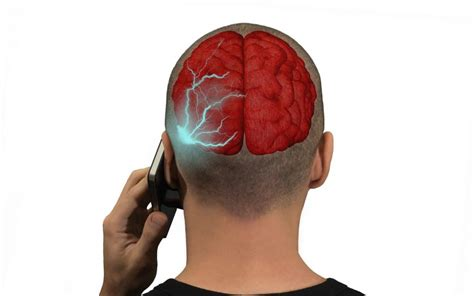
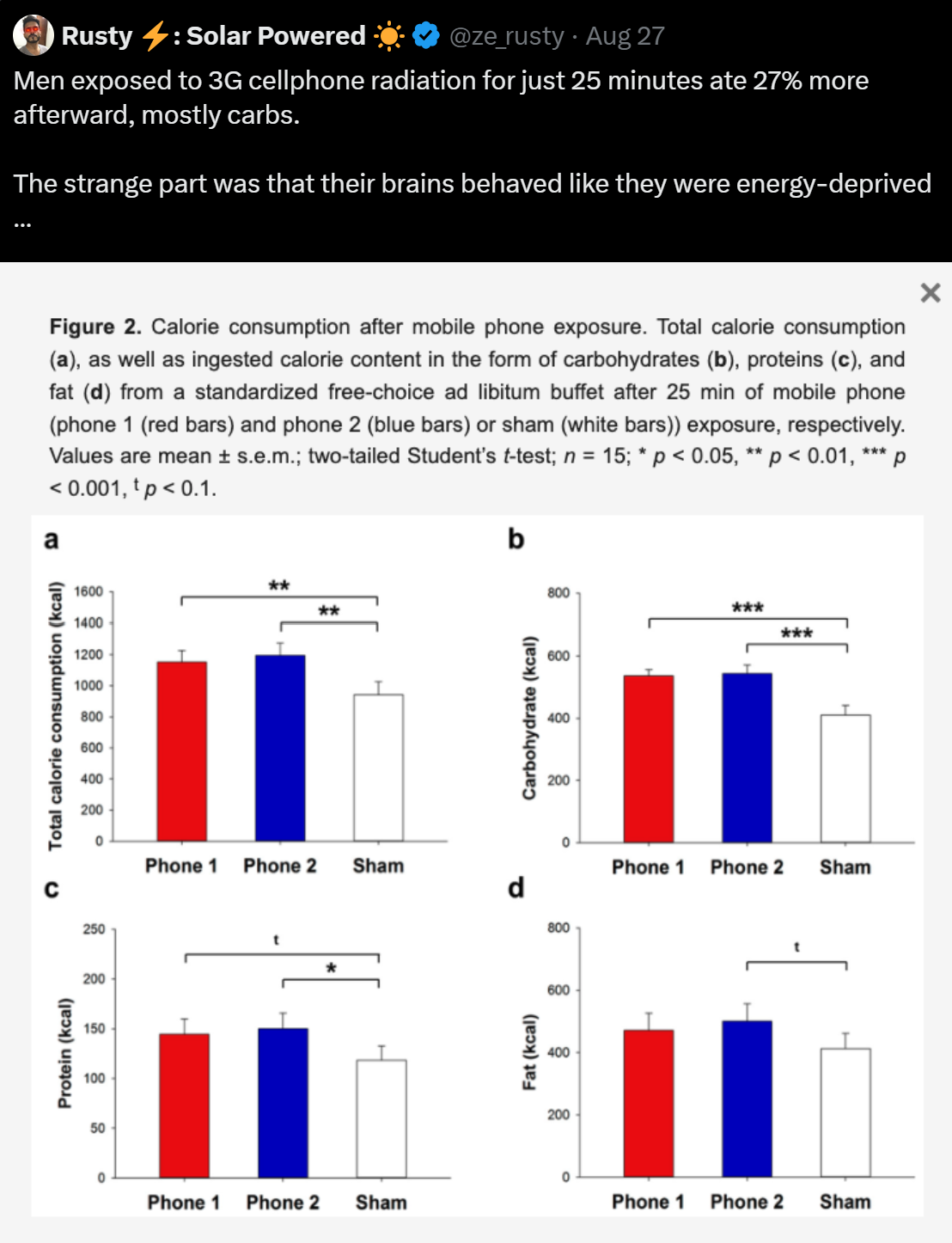
In 2022, researchers at the University of Luebeck ran a randomized, sham-controlled crossover trial: fifteen fasted young men, each tested on separate days under two conditions — 25 minutes of actual mobile phone radiofrequency radiation (GSM 900MHz, the same band as 3G) from two different phone models, versus a "sham phone" condition, where an identical-looking phone sat in the same headset but was switched off, delivering no radiation at all. Nobody knew which condition they were in on a given day — the phone gave no sound or visual cue either way — so any difference in behavior couldn't be explained by expectation.
The result: both active phones increased total calorie intake by 22–27% compared with the sham condition, and when the researchers broke that down by macronutrient, the extra calories were concentrated almost entirely in carbohydrates. Not more of everything across the board — specifically more carbs. Thirteen of the fifteen participants showed the effect.
The stranger finding was in the brain scans. Using phosphorus MRS to track cerebral energy metabolism in real time, the researchers found that the brain's high-energy phosphate markers — ATP and phosphocreatine, relative to inorganic phosphate — actually rose after phone exposure rather than falling. In plain terms: after 25 minutes of phone exposure, the brain's own energy readings went up, not down — yet the person still reached for more carbohydrates, as if the brain were signaling scarcity it didn't actually have. Among the best, most knowledgeable experts in the EMF-mitigation space I've come across, Rusty: Solar Powered on X, put the study bluntly: "The strange part was that their brains behaved like they were energy-deprived EVEN though the rest of the body wasn't."
This is where the two studies rhyme in an uncomfortable way. Sunlight nudges the brain's energy and inflammatory signaling toward less glucose need. Phone radiation, at least acutely, appears to nudge it toward more carbohydrate-seeking — even while cerebral ATP readings are elevated. Same signaling territory — nitric oxide, mitochondrial energy status, autonomic regulation — pulled in opposite directions by two very different, very modern exposures.

Dr. Jack Kruse's read on the original glucose study, shared on X after it dropped: "Humans in sunlight reduce blood sugar by 27%." Rusty's follow-up framed the seasonal pattern precisely: the sunlight-glucose relationship was strongest in winter — "exactly when natural light is hardest to get... Nature seems to punish the light-starved state hardest."
What This Actually Means for Your Health Stack: What You Can Do Today
None of this requires becoming a hermit who avoids Wi-Fi or moving somewhere with year-round UV index of 8. It means:
- Winter is when your ambient light deficit is doing the most metabolic damage — and it's also when a modest correction (morning light, less time entirely indoors, red/near-infrared exposure) produces the steepest improvement, per the paper's own non-linear curve
- The vitamin D pill isn't the intervention. It never was. The nitric oxide and mitochondrial pathways don't come in capsule form. Breath Light, Slow and Diaphramatically, exclusively through your nose, day and night to increase NO production naturally and for free.
- Every hour on a call with a phone against your head, or a laptop and router within a few feet, is happening in the same biological territory that governs your appetite for carbohydrates — worth knowing if you're fighting cravings you can't otherwise explain. Reduce EMF exposure to reduce carb cravings.
- Diet alone — even a well-executed carnivore or keto protocol — doesn't correct for either variable. Both are upstream of what you eat. Prioritize upstream factors of dysfunction like EMF radiation and light environment as much as the food you eat.
🧬 RADICAL VERIFICATION
Health is wealth. You wouldn't manage your financial stack by vibes. So why manage your health stack that way? Functional labs show your actual glucose regulation patterns, inflammatory markers, and mitochondrial function — not the "normal range" statistical average of a mostly sick population that standard blood panels are built around.
This is the actual rabbit hole: verifiable, individual data instead of another opinion about what you should be doing.
Contact Your Health Detective
The Choice Between Guessing and Verifying
The dermatology establishment in the US isn't going to update its guidance because one paper landed in Scientific Reports. Institutions move slowly, and simple rules are sticky even when the data underneath them has shifted. Australia needed a decade and a 26,000-person randomized trial before it budged. The US still hasn't given an inch.
You don't have to wait for that consensus to catch up before you act on what the data already shows. You don't need the AAD's permission to notice that your body responds to sunlight in ways a vitamin D pill can't replicate.
What you do need is a clear picture of where you actually stand — not another protocol borrowed from someone whose biology, latitude, and life don't match yours.
Stack your health like you'd stack your wealth. Verify, don't guess.
| |||||||||||||||||||



Cites
- Stevenson, A.C., Weller, R.B., Lindqvist, P. & Dibben, C. (2026). "Sunlight exposure is associated with lower blood glucose levels and type 2 diabetes." Scientific Reports. https://doi.org/10.1038/s41598-026-66100-4
- Wardzinski, E.K., Jauch-Chara, K., Haars, S., Melchert, U.H., Scholand-Engler, H.G. & Oltmanns, K.M. (2022). "Mobile Phone Radiation Deflects Brain Energy Homeostasis and Prompts Human Food Ingestion." Nutrients, 14, 339.
- Jacobsen, R. (2024). "Against Sunscreen Absolutism." The Atlantic, June 2024.
- The Economist (2024). Coverage of Weller et al., UK Biobank UV exposure and mortality study.
- X posts: @DrJackKruse, @ze_rusty (August 2026).
Note: This newsletter is for educational purposes only and is not intended to diagnose, treat, or cure any medical condition. Always consult with qualified healthcare providers regarding any health concerns.